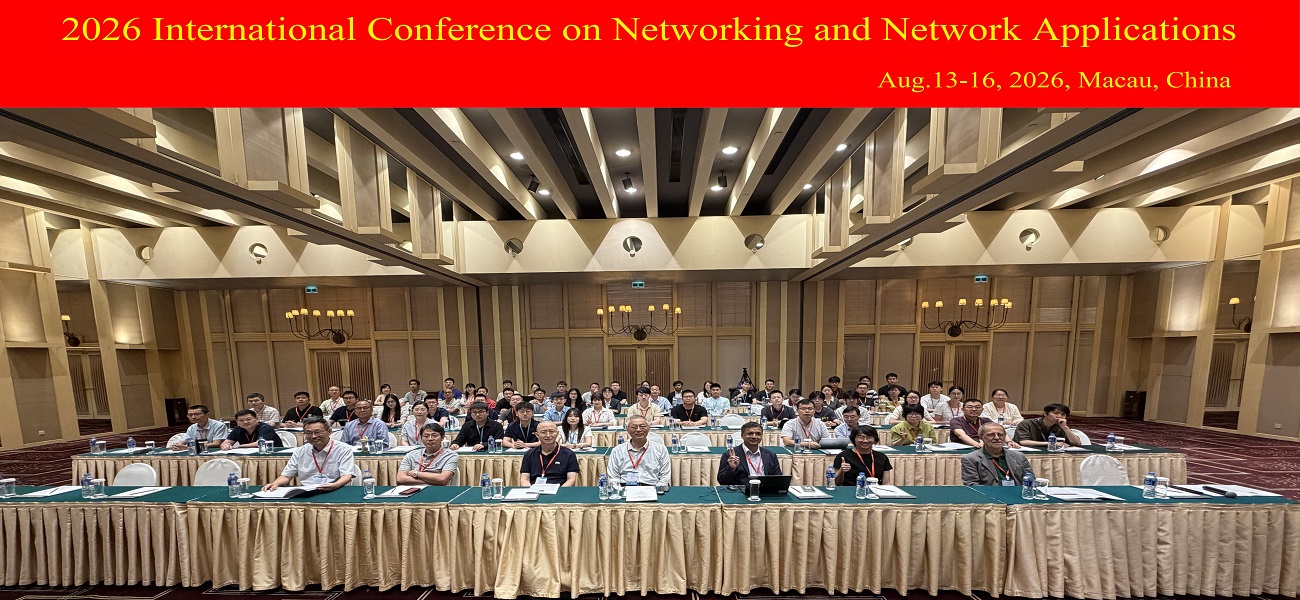
NaNS 2027 seeks papers on all areas of the design and use of future high-performance networking technologies and network security solutions. Instructions for authors are posted on the conference website: https://www.nana-conference.org/.
Topics of interest include, but are not limited to:
Track 1: Wireless Networks
* 5G, 6G and Beyond
* Wireless Ad Hoc, Mesh and Delay Tolerant Networks
* Cognitive Wireless Networks
* Wireless Sensor Networks
* Mobile Internet and Mobile Social Network
* Wireless Vehicle Networks
* Emerging Wireless/Mobile Applications
* Signal Processing for Wireless Communications
* Molecular Communication and Nanonetwork
Track 2: Wired Networks and Data Center (DC) Networks
* Novel Architectures and Technologies for Wired Networks
* Wired Network Control and Management
* Advances in Routers and Switches
* Convergence of Wired and Wireless Networks
* DC Network Architecture & Protocols
* DC Storage Architecture
Track 3:Quantum Computing and Networking
* Quantum Computing Architectures and Systems
* Quantum Communication and Quantum Networks
* Quantum Internet and Quantum Network Protocols
* Quantum Resource Discovery, Management and Scheduling
* Distributed and Cloud-Based Quantum Computing
* Quantum–Classical Hybrid Computing and Networking
* Quantum Algorithms and Network Optimization
* Quantum Network Simulation, Testbeds and Application
Track 4:Large Language Models (LLMs) and Generative AI for Networks and Communications
* Foundation Models for Networking and Communications
* Large Language Models (LLMs) for Network Design, Management, and Optimization
* Generative AI for Network Automation and Self-Healing Networks
* Retrieval-Augmented Generation (RAG) for Network Knowledge Management
* AI Agents and Multi-Agent Systems for Network Operations (AIOps)
* Edge AI, Distributed Training, and Federated Learning for LLM Applications
* Multimodal AI for Network Analytics and Intelligent Communications
* Digital Twins, Simulation, and Synthetic Data Generation for Networks
* LLMs for Internet of Things (IoT), Smart Cities, and Cyber-Physical Systems
* Energy-Efficient and Green AI for Communication Networks
* Benchmarking, Evaluation, and Real-World Deployment of LLM-Based Network Solutions
Track 5: Network Applications
* Architecture and Systems Design for the Internet of Things (IoT)
* IoT Applications and Services
* End-to-End / Machine-to-Machine (M2M) Protocols
* Crowd-Sourcing and Opportunistic IoT
* Innovative Algorithms and Data Analysis Techniques for IoT
* Fundamentals of Cloud Computing
* Cloud Architectures & Cloud Storage Technologies
* Cloud Energy Efficiency
* Mobile & Social Cloud
* Deployments, Testbeds and Field Trials
Track 6: General Network Security Issues
* Security & Privacy in Wireless Networks
* Security & Privacy in Wired Networks
* Resilience Design for Wired/wireless Networks
* Physical Layer and Cross-Layer Security Methods
* Disaster Readiness and Management
* Security in Space-Air-Ground Integrated Networks
* Security in Drone Communication Systems
* Security in Quantum Communications and Networks
* Safety Issues for Communication Networks
* Quantum Security and Quantum Key Distribution (QKD)
Track 7: Security of AI/ML-Enabled Networks
* AI/ML for Network Security
* AI/ML Enabled Secure Communications
* AI/ML Security in AI/ML-Enabled Networks
* AI/ML-Enabled Network Monitoring
* Security Testbeds for AI/ML-Enabled Networks
* Explainable, Trustworthy, and Responsible AI for Networking
* LLM-Assisted Network Monitoring, Troubleshooting, and Root Cause Analysis
* GenAI for Cybersecurity, Threat Detection, and Incident Response
* Privacy-Preserving and Secure LLMs for Communication Systems
Track 8: Network Data Security
* Network Data Protection and Integrity
* Big Data Security Theory
* Security-aware Big Data Placement, Scheduling, and Optimization
* Security-aware Big Data Design, Models and Algorithms
|